

Great Britain rules, UK tax context and player decisions
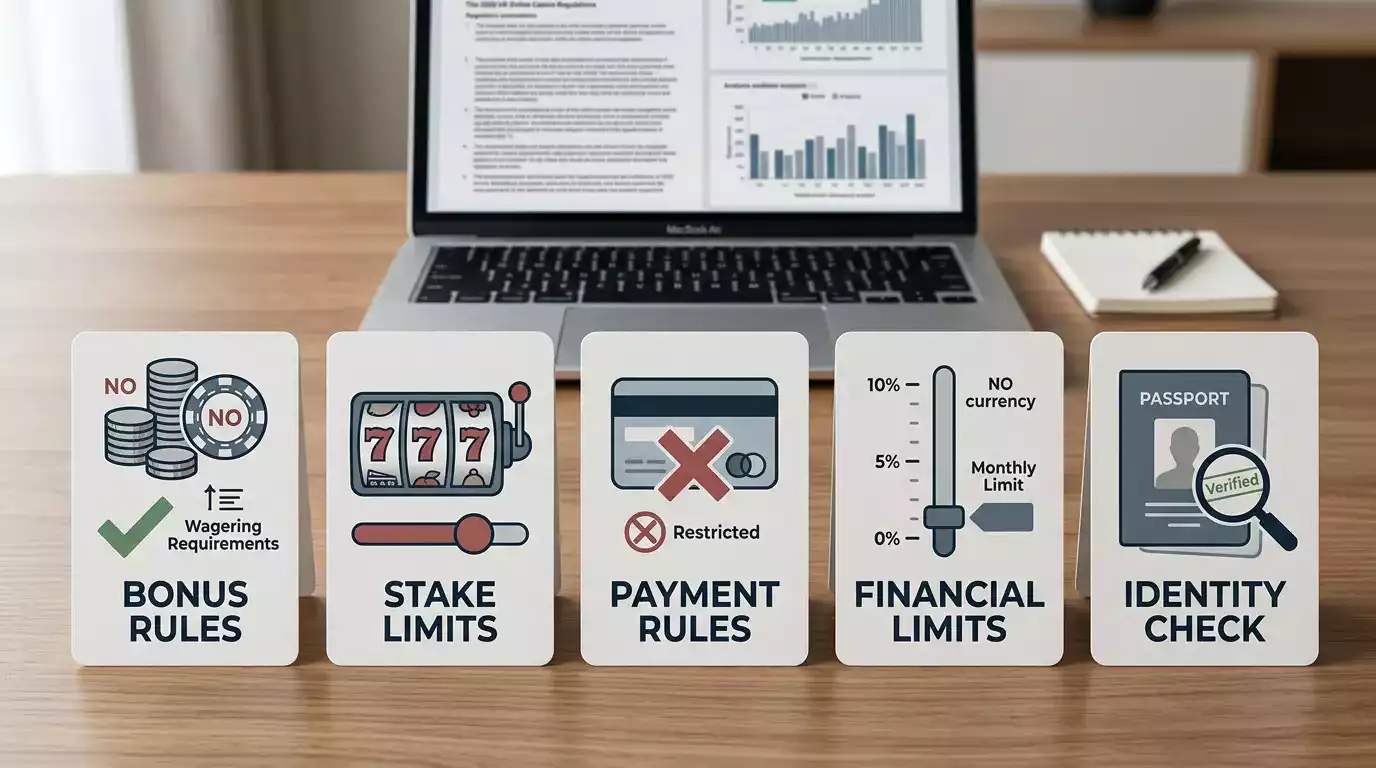
UK online casino rules 2026 affect how a WinOMania reader should assess bonuses, slots, deposits, account controls and verification. As checked on 27 May 2026, the most decision-relevant Great Britain rules include a bonus wagering cap of ten times (10x) the bonus amount, online slots stake limits of £5 for adults aged 25+ and £2 for ages 18-24, restrictions on credit-card and credit-card-funded wallet gambling payments, age and identity checks before gambling, and financial-limit prompts from registration or first deposit/payment. This guide is not legal advice. It uses Gambling Commission language for Great Britain gambling regulation and UK/HMRC language for tax and operator-duty context.
Key UKGC Regulatory Rules and Player Safeguards
The rules below do not replace the current WinOMania account terms, cashier or help pages. They explain the regulatory background that should shape how UK readers interpret those pages. A register entry can support the UK-facing brand check, but it does not tell you your bonus status, current deposit method, exact document request or withdrawal timing.
| Rule area | What it affects | Practical WinOMania check |
|---|---|---|
| Bonus wagering | Promotional terms and withdrawable bonus winnings. | Read the current offer terms before accepting a bonus. |
| Online slots stakes | Maximum stake controls for online slots. | Do not judge slots only by title choice or jackpot labels. |
| Credit-card restrictions | Direct card use and credit-card-funded wallet payments. | Use compliant deposit routes shown in the cashier. |
| Financial limits | Registration, first deposit and account-control prompts. | Set and review limits deliberately instead of rushing the prompt. |
| Age, identity and safer gambling | KYC, account monitoring and self-exclusion tools. | Keep account, payment and withdrawal details consistent. |
Bonus wagering cap and mixed-product promotion caution
The Gambling Commission socially responsible incentives changes limit bonus wagering requirements to ten times the bonus amount and restrict the way mixed-product incentives are constructed. This is a rule-context point, not a claim about the current WinOMania welcome package. In this project, exact current WinOMania bonus values and detailed terms were not verified from an opened official bonus-terms page, and third-party listings conflicted.
For players, the practical lesson is to read the current offer before opting in. A bonus headline can hide wagering, maximum bet, eligible-game, expiry or conversion rules. The regulatory cap reduces the risk of extreme wagering requirements in Great Britain, but it does not make every promotion suitable for every player. A bonus can still affect when winnings become withdrawable and which games count toward wagering.
Use the WinOMania bonus guide for the brand-specific caveats. Do not treat a bonus code, old review table or copied social post as safer than the current terms displayed to your account.
Online slots stake limits
Great Britain online slots are subject to maximum stake limits of £5 for adults aged 25+ and £2 for adults aged 18-24. Gambling Commission guidance says the £5 limit went live on 9 April 2025 and the £2 limit for adults aged 18 to 24 went live on 21 May 2025. The guidance is about online slots, not every casino product.
For WinOMania, this matters because slots are one of the reported core game categories. A slots page should therefore judge the category by more than game count or visual style. Stake controls, account limits, bonus eligibility and safer-gambling prompts all affect the real playing experience. The slot and jackpot checks page covers the game-category view without claiming exact current title counts.
Players aged 18-24 should pay particular attention to age-related account data because the lower limit depends on age category. That is another reason the identity checks page treats accurate registration and verification details as part of responsible account setup.
Credit-card and wallet funding restrictions
Gambling businesses in Great Britain must not accept credit card payments for gambling. The Gambling Commission also states that the credit-card ban extends to payments made through money service businesses such as e-wallets and other fintech or electronic money institutions where credit cards can fund gambling payments. This means a credit-card-funded wallet workaround should not be treated as a valid deposit strategy.
For a WinOMania reader, the cashier should be read through that rule lens. Reviewed sources have reported familiar UK-facing deposit categories such as debit card, PayPal, Skrill, Neteller, Paysafecard and Neosurf, but exact account availability can change. The live cashier is the account-level source, and the deposit checklist explains why funding source and payment ownership matter.
Many UK banks also offer gambling transaction blocks for bank accounts or debit cards. Those tools are separate from a casino cashier. If you use a bank block, do not assume the casino can override it, and do not try to bypass it by shifting spend to borrowed money. The safer decision is to pause, review limits and use account controls before funding any gambling account.
Financial-limit prompts and the 2026 deposit-limit update
Licensed online gambling systems must provide customer-led financial-limit facilities and prompt customers to set a limit at registration or first deposit/payment. Gambling Commission material also describes periodic prompts to review account and transaction information. In May 2026, the Commission extended the implementation period for the second phase of deposit-limit changes from 30 June 2026 to 30 September 2026.
From 30 September 2026, the Commission says operators must offer gross deposit limits to customers, name gross deposit limits as deposit limits and give those limits at least equal prominence with other financial limit types. That update concerns how limits are defined and presented; it should not be confused with a permission to gamble without controls until that date.
For WinOMania account setup, the useful behaviour is stable across the timeline: read the limit prompt, choose a meaningful limit if you continue, save the confirmation and review it before adding more funds. The sign-up checks page explains how limit prompts fit into registration rather than treating them as an obstacle to skip.
Age, identity and account monitoring
Online gambling businesses must ask customers to prove age and identity before gambling. Remote operators also have customer-interaction duties that require systems and processes to monitor customer activity and act on indicators of harm. Those two ideas can meet inside a real account journey: a player may see ordinary identity checks, payment ownership checks, safer-gambling questions or source-of-funds questions depending on account activity.
The important WinOMania caveat is that this guide does not publish a fixed document list or a fixed KYC processing time. Those details were not verified from an opened official WinOMania help page and can change by account case. Use the KYC verification guide for document-list caveats and practical preparation steps.
This is also why player availability should not be simplified into a single yes/no promise. The availability caveats page separates register-domain evidence from individual account acceptance, payment availability, bonus eligibility and verification outcome.
GAMSTOP, self-exclusion and safer-gambling information
The Gambling Commission has stated that all Gambling Commission-licensed online operators must participate in the multi-operator self-exclusion scheme GAMSTOP, and current Commission player guidance describes GAMSTOP as a way to self-exclude from online operators with one request. Remote operators must also have self-exclusion procedures and take reasonable steps to prevent gambling and marketing during a self-exclusion.
Licensed operators must make safer-gambling information readily available, including how to gamble responsibly and how to access information and help in respect of problem gambling. A player should therefore expect account controls, safer-gambling links and self-exclusion information to be part of the compliance environment, not optional decoration.
For WinOMania, use the trust and complaints guide to place safer-gambling tools alongside licence checks, complaint routes and support caveats. This page avoids creating a separate responsible-gambling article because the plan deliberately keeps current UK rule changes in one practical location.
Advertising and promotion rules
UK gambling marketing must be socially responsible and comply with the UK advertising codes and relevant LCCP requirements. ASA and CAP guidance also emphasises the rule that gambling ads must not be likely to have strong appeal to children or young persons. This matters even on editorial pages because promotional tone, imagery and calls to action can create misleading pressure.
This guide therefore avoids urgent registration language, fake countdowns, invented ratings and youth-appeal imagery. It also avoids treating a promotional bonus as the main reason to play. A safer review should explain where an offer is uncertain, how wagering affects withdrawals and which current-term checks come before account funding.
If a WinOMania promotion appears to mix product types, imply risk-free gambling or push speed over understanding, read the current terms and compare them with the rule context before opting in. The practical question is not only whether a bonus exists, but whether the structure is clear enough for you to use without confusion.
Tax and operator-duty context
HMRC guidance indicates that gambling activity by a player, even when systematic or successful, is not normally treated as a trade. This is a general context point, not personal tax advice. Individual circumstances can differ, and this page does not advise readers on tax treatment, residence or unusual income situations.
Gambling duties sit mainly on the operator side. GOV.UK states that Remote Gaming Duty increased from 21% to 40% from 1 April 2026, and HMRC guidance describes Remote Gaming Duty as charged on a gaming provider’s profits from remote gaming with UK persons. The statutory gambling levy also commenced in April 2025 and replaced the previous voluntary industry contributions system for research, prevention and treatment funding.
For a WinOMania player, the important point is not to confuse operator-facing duties with a cashier fee. If the account shows a fee, limit or deduction, judge it from the current cashier and terms. Do not assume that a government duty automatically appears as a separate player charge.
Decision checklist before using WinOMania
- Check the licence and operator check before using any domain or login route.
- Read bonus terms through the wagering-cap and mixed-product promotion context, not through a headline alone.
- Use the slots rules when assessing game play, especially if the player is aged 18-24.
- Confirm the current cashier route and do not use credit-card or credit-card-funded wallet workarounds.
- Set financial limits deliberately before funding the account.
- Prepare for age, identity, payment ownership and possible source-of-funds checks.
- Use bank blocks, self-exclusion and account controls when gambling spend is no longer controlled.
For the broader brand view, return to the full WinOMania review. The non-generic takeaway is that UK rules make thin casino reviews less useful: the real decision is evidence quality. Check current terms, current cashier prompts, current account controls and current verification messages before treating a bonus, slot category or deposit method as suitable for you.
Material created by the team WinOMania